
Alison had a day off work today so we spent much of it checking out the lower part of the first stage of the route (from Buntingford to New Malden) with special emphasis between Buntingford and Willesden as the route through London will not be difficult. So, we were checking out the nature of the country roads we expect to be walking and the appearance of the footpaths we hope to use.
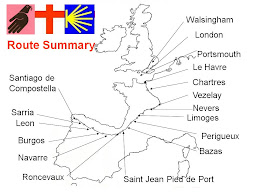
It was a very successful day! So, now we know that we will walk much of the Ely Leg route in reverse to Ely then down the river to Cambridge and through to join the London route to Buntingford before striking South West towards Barnet then Willesden and New Malden.
So, why Willesden? Is it because one of our daughters has a boyfriend from that charming suburb of olde London Towne? Methinks this is not actually the primary reason. There is a more cunning plan afoot!
Quite simply, Willesden was a major medieval pilgrimage site with a major shrine devoted to Our Lady – not too dissimilar to Walsingham. It started a bit earlier as the date of the foundation of the Parish Church of St Mary was 938 during the reign of King Athelstan (who probably gave the church Mary related relics) and, by the time of Walsingham it was beginning to be visited as a shrine. Around the time that Walsingham obtained its mother and child statue Willesden had a black statue of the mother and child, too. Oh, and Willesden had its own holy and miraculous spring, or well, too. The name gives the game away, really – Will (a corruption of well, es (of or under) and den (or hill). The church still has the water source in its crypt, too!
When the authorities were trying to stamp out all Catholic practices in England they found the Marian cult one of the hardest things to deal with and so the Marian shrines really saw some of the harshest treatment. This become such a focussed course of action that, in the end, in 1538 the Lord Privy Seal had, amongst others, the Mary statues from Walsingham, Ipswich, Worcester and Willesden burnt at Chelsea as if they were living people. It was a very dramatic way of saying that the devotion of Mary was now dead....
During roughly that same time the Lady Chapel at Ely was stripped of its wealth, the glorious windows were destroyed and all of the carvings removed or defaced. Along with the religious bling and tat, great treasures of art were destroyed and a very English form of devotion was all but lost.
It was not until the nineteenth century that these places began to see any significant reawakening and it was the early twentieth century that saw them begin to grow again in importance. Somehow, Willesden has never risen to the significance of Walsingham but it merits considerable recognition as one of the special ancient Marian sites in England.
The point of this is not to give anyone a basic history or church history lesson (my info is too scrappy for that, anyway) but to show that the two places are connected and that walking from one to the other does have some sort of special significance. En passant, Alison and I hope to establish a basic, but logical route between Walsingham and Willesden with a view to possibly even building a regular pilgrimage between these two sites. So, it is a simple task to talk about it and a little task to develop this idea when we come back from our current pilgrimage. I will write the guide book if I can...
Of course, there is also something satisfying in making links and the ones we hope to make between the various places we will walk through will hopefully be more significant than the simple fact that we walked through them. There is a strong historical, emotional and symbolic connection between Walsingham, Ely, Cambridge and Willesden and there are a number of other sites whose links will also become obvious as we explore them, too.
I believe that you can often feel the connection between places as you walk from one to the other. And that is really the point. Today’s expedition has emphasised the joy of discovering these sorts of links and we hope to find more ways of connecting places together - through their people, food, drink, history and character.
This is yet another really good thing to look forward to! Phew!

Subscribe to:
Post Comments (Atom)

 Posts
Posts


No comments:
Post a Comment